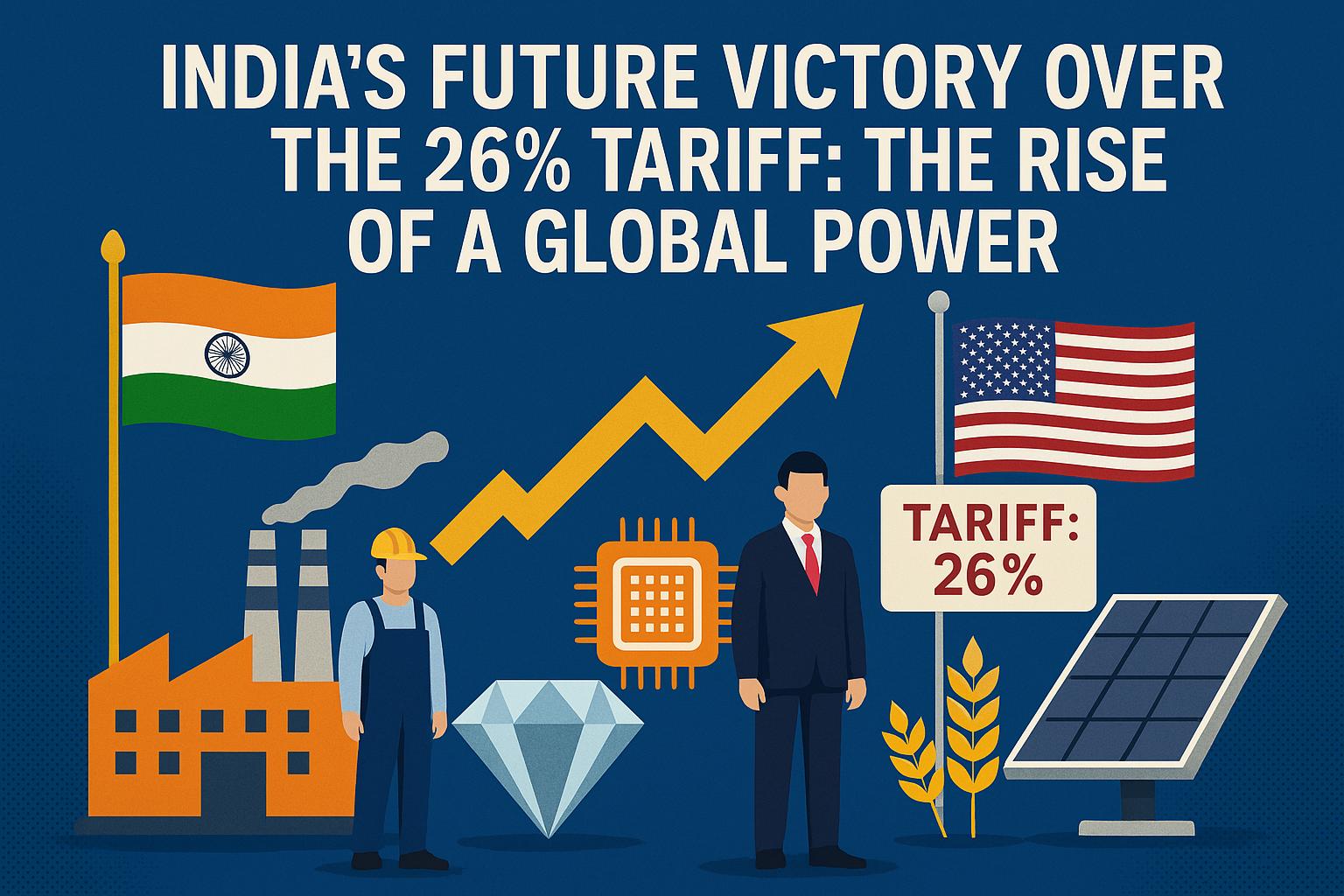
It was April 2, 2025, when Donald Trump, back in the Oval Office, dropped a trade bombshell: a 26% tariff on Indian exports to the U.S., starting April 9, on top of a 10% duty he’s hitting everyone with. That’s a hefty slice of the roughly $81 billion we send to America each year—18% of our goods trade—think textiles, electronics, gems. You’d figure India might punch back, but instead, we’re seeing a different game plan: no rash moves, just a mix of big ideas and hard work to turn this mess into a shot at something bigger. Could this be the push India needs to hit a $5 trillion economy by 2030 and step up globally? Maybe—but it’s not a sure bet yet.
A Tariff That’s Tough, Not Fatal

The U.S. claims our trade rules cost their firms $5.3 billion annually, so they’ve rolled out this 26% tariff. It’s pinching: $14 billion in electronics (including all those parts), $9 billion in gems, and textiles—28% of what we ship over there. Some reckon we’ll lose $2 to $7 billion in exports next year, maybe nudging GDP growth down by 5-10 points. It’s a hit, no doubt, but not a knockout.
Here’s the silver lining: we’re not the hardest hit. Vietnam’s facing 46%, China’s at 34%, Thailand’s at 36%. Our $31 billion pharma exports and $205 billion IT services are sailing through unscathed. This isn’t a crisis—it’s a test, and India’s got some cards to play.
Grit at Home: What’s Working, What’s Not: India’s chasing a $5 trillion economy by 2030 and a richer future by 2047. A tariff won’t kill that dream, but it’s exposing cracks we can’t ignore:
Manufacturing Hopes: The Production-Linked Incentive scheme—₹2.5 lakh crore, or $30 billion—has folks talking. Mobile phone exports are up to $15 billion, and we’re making 26% of what we need at home, compared to 5% a decade ago. But 60% of the parts still come from abroad, and the red tape’s a slog. If we can’t speed up R&D and approvals, this could stall out.
Building Better: There’s $1.5 trillion earmarked for infrastructure—highways, ports with 5G, 35 hubs by 2030. Shipping costs us 14% of GDP now; China’s at 8%. Cut that by 30%, and exporters could dodge some tariff pain. Trouble is, delays and funding gaps have slowed projects before—will this time be different?
Young and Restless: With 65% of 1.4 billion under 35, we’ve got a goldmine of talent. Plans to train 400 million by 2030 sound great, but execution’s been spotty—Skill India’s had its share of hiccups. If businesses step up too, we might see more chips and code, less cotton.
Looking Beyond Uncle Sam: Half our exports lean on five markets—the U.S. takes 18%. That’s a risk, and this tariff’s a wake-up call:
- New Roads : Africa’s $3 trillion market by 2030 could double our $4 billion pharma exports if trade deals click. ASEAN’s got $10 billion in electronics demand. The Export Promotion Mission 2025—₹10,000 crore for small firms—aims to triple their reach, but it’ll take more than cash to crack those markets.
- Cutting the China Cord: We’re $100 billion underwater with China—70% of our electronics parts come from there. Big bets like TSMC’s Gujarat plant and $11 billion in projects could trim that by 20% by 2028. China’s 34% tariff tangle is pushing companies our way, but we’ve got to ease land rules and labor laws to grab that chance.
- Reaching Higher—If We Can: This tariff’s hitting low-end goods hardest. Could we pivot to bigger wins?
- Chip Dreams: A $10 billion Semiconductor Mission wants 10% of the $1 trillion global market by 2030—$50 billion in exports. Ambitious, but we’re late to the game, and talent’s thin.
- Green Gains: We’re at 103 GW of solar capacity, aiming for 280 GW by 2030 as part of a broader 500 GW non-fossil energy target—$30 billion in exports could follow if we scale manufacturing and tap markets like the U.S., Africa, and ASEAN. Steel tariffs hurt, but this could pay off if costs align and we boost domestic production.
- Farm Smarts : Our $391 billion agri-sector could boost profits by 25–30% with processed goods, adding significant value through products like packaged foods and exports. Farmers need help to get there, though—government promises don’t always deliver, with delays in funding and infrastructure support slowing progress.
Playing It Cool Globally: India’s not biting back like China with its 34% counterstrike. “Mission 500” eyes $500 billion in U.S. trade by 2030—talks over tariffs. Deals with the UK, EU, and Canada by 2026 might add $50 billion. At the G20, we’re pitching a “fair trade compact,” but our own high tariffs—like 100% on soybeans—leave us open to flak. A little give could go a long way.
The Long Road Ahead: Losing $2 billion in 2025—0.1% of GDP—isn’t much when exports are just 10% of our economy. China’s dumping with its 54% tariffs? The WTO could help. By 2030, we might be in the driver’s seat—if we don’t trip over our own feet.
The Bigger Picture: This 26% tariff’s a hurdle, not a wall. India’s got the strengths—grit, youth, ideas—to build a $5 trillion future. Will it all come together? That’s the gamble. By decade’s end, 2025 could be the year we flipped a trade snag into a global leap—or a reminder to move faster. Either way, India’s not just hanging on; we’re pushing forward.
Team POV
Disclaimer: The data and projections in this article are based on the latest available sources as of April 2025. If you find any discrepancies or mismatched data, please inform us with credible references. If the information is verified and found to be correct, we will update our story accordingly.